Salmon and avocado aperitif and an old brown suitcase(aperitif de saumon aux avocats et la vieille valise)

It is time to start baking cookies for Christmas. Time to think about the menu and order your meats. time to think about  some aperitif to toast with your champagne. And time to dig up the old memories.

Salmon and créme frâiche with blinis and topped with some caviar is an old favourite for high occasions. And loved by all. By changing and adapting it a little, we can still enjoy tradition ; bringing in some new without throwing out the old. Spark it up a bit, freshen it up.
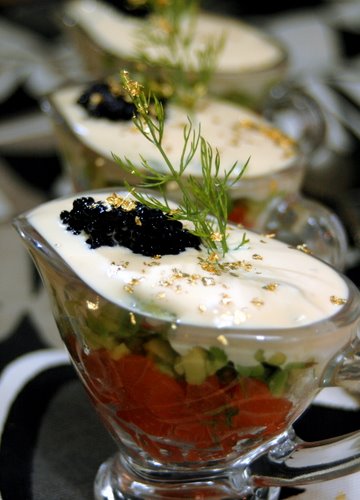
Suggestions:

  1. Serve the aperitif with some blinis on the side.
  2. It can be made in bigger portions and served as a starter.
  3. Créme frâiche can be added to the mayonnaise to make it creamier…add to your taste.
  4. Before topping the glasses with the mayonnaise/créme frâiche mixture, leave for about an hour in the fridge to become a bit more firm, or else it will be too runny.
  5. Instead of the smoked salmon a tartare of good raw salmon can be used.
  6. Use tomatoes instead of salmon if you are a vegetarian.
  7. Don’t use an expensive caviar for the topping..a lumpfish caviar works fine.
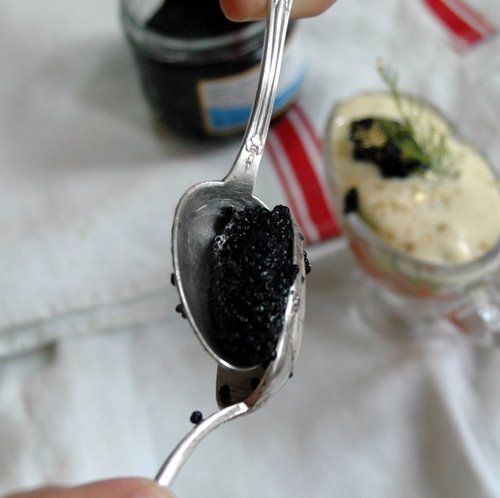
  8. To make a quenelle of lumpfish caviar: use two spoons and slide a dollop of lumpfish caviar alternatively between the two spoons until you have an olive shaped quenelle. Slide the one spoon from front to back on the second spoon under the quenelle. Repeat once  or twice until you are happy with the shape.  See photos above.

…shaping a quenelle…

During Decembers I have a habit of digging up all old things and remembering. That is what I think winter is for after all. Reflection. Reminiscence. I reorganize drawers and closets, throw out old magazines, go pick them back up an hour later…Browse until early morning hours through old photo albums, discover old letters….like my own and those of my parents. The ones we dug up in our cave in the garden. Photos and letters are stories. They make us cry. They take us back on distant roads and make us laugh. They make us glance in the mirror to see the traces time had left.

…good wishes and happy writings…

…an old brown suitcase for embracing  old memories…

How will we be remembered and looked upon one day? Will someone have an old filled suitcase somewhere  where our picture dwells? Or will our picture appear in a virtual realm in a hyper contemporary room…or not at all. Will someone also look at us and cry and laugh at once upon a time…

…once upon a time…
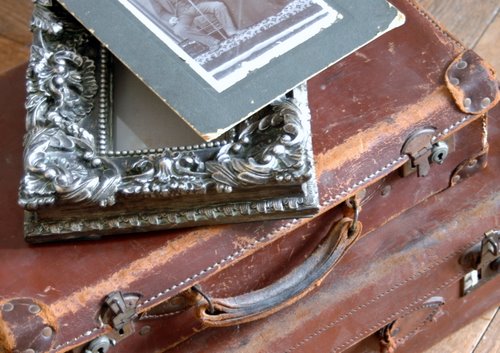
Somewhere old becomes mingled with the new and we wonder…when is old really old.  Memories have no sense of time. Yesterday can be long ago and tomorrow can still be far away.

…a mix of old and not so old…

May I never forget. May my brown suitcases never be empty.

Do you have an old brown suitcase?

*Truc et astuces de grand-mére:

If your vinaigrette is too salty, place a cube of sugar on a teaspoon and rest it in the vinaigrette for about 10 seconds to absorb the salt and then remove the teaspoon with sugar cube.
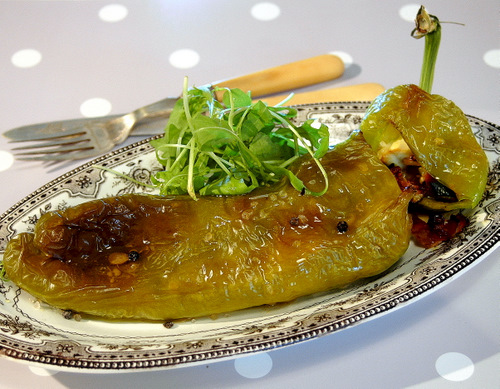
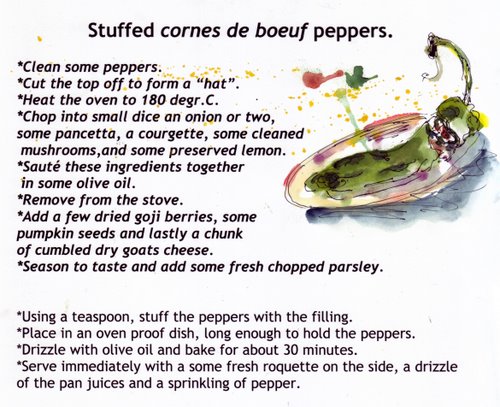
Stuffed cornes de boeuf peppers and a book on food and painting.

These cornes de boeuf peppers from Spain lend themselves ideally to stuffing and they are fascinating with their long and twisted shapes.

…cornettes de boeuf…


stuffed cornes de boef recipe

Suggestions:

  1. Any filling can be used…mushrooms, onions, peppers, courgettes, cheese, berries, broccoli florets, tomatoes, dried fruits, breadcrumbs, left over chicken, ground beef, quinoa, rice, lentils…
  2. Ordinary  sweet peppers or courgettes can be used instead of the peppers. Or more piquant peppers.
  3. Can be served as a starter or a vegetable accompaniment, or even a whole meal served on a green salad with a mustard vinaigerette.
  4. When stuffed tightly with a crumbs filling, it can be sliced and served as an aperitif on canapés, with a moelleux wine, (a sweet, fruity white wine).

In Octobre I  had an art friend visiting France and she stopped through here in Touraine, where we met for the first time after being blogging friends for a long time. See both her sites, Making a mark(in which she covers much more information than just art – her latest post is about Technorati and blogosphere…have  a look)  Travels with a sketchbook is all about her sketching and travelling.

Katherine and her sister and niece had dinner with us at home on their last night here and they brought me a beautiful book – Boire et manger that I wish to share with everybody. It is such an inspiration, seeing how food and art have walked hand in hand through all ages, depicting the habits and cultures and changes of the times and the different symbolisms of different foods, some of which we still hang onto today; cherries being a symbol of love and volptuousness, bread being the symbol of the body of christ, the apple seen as the origin of sin. I wish I could share the whole book with you, but here are a few excerpts. I hope they delight you as much as they did me and inspire you to be creative with food, not that I mean to paint it, but to “paint with it”! And above all, to respect it!

You can see more examples on Africantapestry at Food sketches and a book on dining a painting.

boire et manger

…jeunes garcons mangeant des fruits: Bartolomé Esteban Murillo(1645-46)

Jeunes garcons mangeant des fruits - bartolomé esteban Murillo(1645-46)

Le melon-meaning: Sweetness, earrthly pleasure, friendship.

  1. Maybe  look between the two boys could be interpreted as a silent dialogue between them to decide which fruit they prefer; the grapes or the melon, both having existentially different symbols.
  2. In the mythical sense the melon symbolically represents the earthly sweetness and pleasures of the flesh.
  3. the melon is always not only the cosen sweet ness of both adults and children, but a symbol of friendship, because the quality of the kin of the melon can determine the quality on its flesh.
  4. Grapes, givng birth to wine, could be reference to the spiritual path and the need to follow it.

…la table d’office: Siméon chardin(1756)…

La table d'office -Jean Baptise Chardin(1756)

Olive and oil – meaning: Grace of the Holy Ghost, conscience, clemency and charity.

  1. The European porcelain soupterine accentuates the refinement of the table.
  2. Two coilcans are presnt- one for oil and one for vingar, the usage of both these condiments togheter would be reaffirmed during the ages.
  3. The rustic terrine had a specific culinary function, which was the making of paté and was typically French cuisine.
  4. This still life present a contrast between elegance and rustic in the display of the kitchen tools and refined tableware. Chardin was fascinated by the culinary arts and gastronomy and used both at the same time to create his art.
  5. The silver warmer with silver seen as a noble metal, was part of the refined table and added to the elgance of the piece.

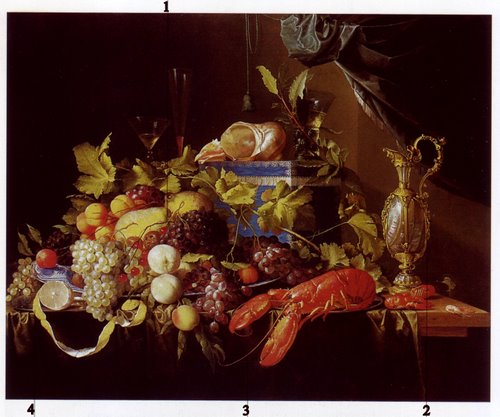
…nature morte avec des fruits et un homard: Jan Davidsz de Heem(1648-49)

Nature morts avec des fruits et un homard - Jan Davidsz de Heem(1648-49) containers- meaning: the human condtion, refers to the content held within container

  1. The fruit represent the earthly pleasures and in deeper context they represent the joy of the spirit/mood.
  2. The ornate decoration on this pure precious metal container represents its excellence and gives it a symol of saintly spirituality.
  3. The lobster is a symbol of resurrection.
  4. The peeled lemon represents life; which gradually “peels” off the outer earthly layers to finally arrive at the soul.

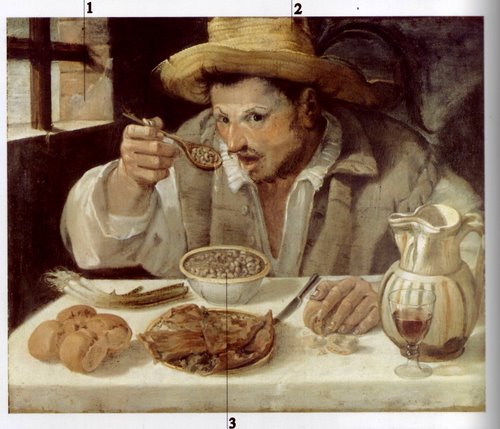
…le mangeur de haricots:Annibale Carrache(1583-84)…

Le mangeur de haricots-Annibale Carrache(1583-84)

Dried beans- meaning: humility, poverty, continence

  1. the borken windeow represent the negligence of this humble environnement.
  2. The man eating the beans was a subject reintroduced to painting at beginning of the XVI century. Up until then this theme  was only kept to the indignant.
  3. The dried bean was condidered the most humle of the starch food and and represents the everyday food of the common peasant.

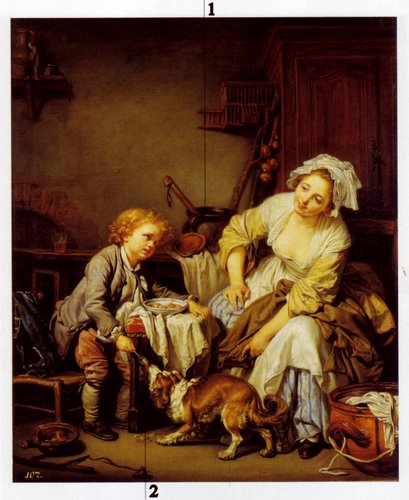
…l’enfant gaté: Jean Batiste Greuse(1865)

L'enfant gaté -Jean Baptise Creuze(1765)

Cutlery- menaing: Elegance, finesse, treason, word of God.

  1. The presence of the cauldron emphasizes the popular character of the represented scene.
  2. The little boy holds a silve spoon, which contrasts with the humble and diorganized environnement. During this era, a silver spoon was given to children, because silver was believed to have antibiotic properties.