A deliciously moist and quick cake to satisfy some desire for sweetness. Mix all together and put into the oven and by the time you’ve wiped the counter and made a fresh pot of coffee, your cake will be ready. Dust swaggeringly with icing sugar, put onto a fancy platter and voila…an appealing and flirtatious invitation on a plate… a Valentine one…

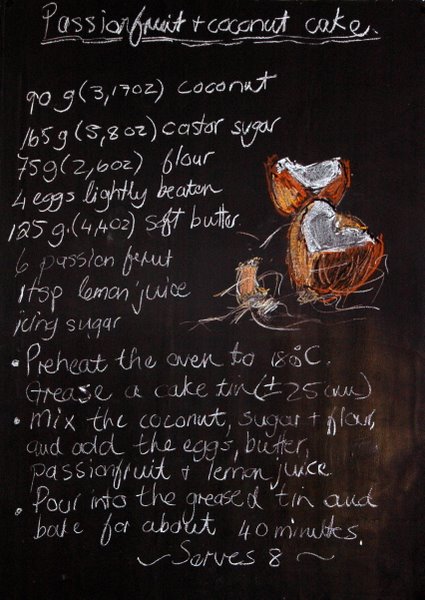
Suggestions:
- Don’t overwork the batter! It is a light mixing of all the ingredients together…NO creaming of the sugar and butter etc beforehand.
- The amount of flour is CORRECT! The amount IS enough to bind the cake…It doesn’t have much flour, therefore the moistness of the cake. It is not a light, fluffy cake.
- See to it that your butter is very soft.
- Be careful of too much lemon juice, for the passion fruit already has some sourness.
- One medium passionfruit gives about 30 ml (1,015 fl ounces) of juice.
- Any other exotic fruit can used instead of passion fruit…pineapple coulis, mango coulis…
- Use about 180 ml (6.09 fl ounces)of mango(or pineapple) puree/coulis for the equivalent of 6 passionfruit.
- Don’t skip the dusting of icing sugar, it rounds off the cake and adds a little zing to the taste.
- The cake can be served as a dessert as well, along with some fresh strawberries or a glass of fruit salad.
- It is even tastier the next day.
- It can be served slightly warm with a dollop of whipped cream…if the hips allow!
- If the hips are struggling, lock the rest of the cake away and go leave the keys with your strictest neighbour.
This is a recipe from Meilleurs desserts from Marabout chef.
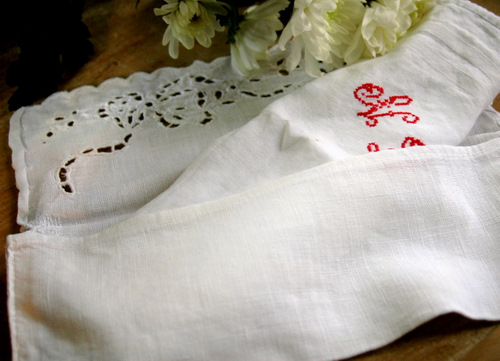
In a previous post I talked about my love for fabric napkins. A while ago Madame Brocante held these beautiful napkin holders aside for me at our local Sunday brocante. They were used for everyday fabric napkins. Every member of the family gets a napkin and a holder/pocket which belongs to him/her. Usually each family member’s name was embroidered on the holder to distinguish it from the other napking holders. With each meal you would get your same napkin and you would use it again until it is dirty enough to be washed. In ancient times, washing was a difficult and tiresome, not to mention long and elbow grease process, so it didn’t happen daily or even weekly like we are so used to today.These poches are still very much in use for everyday family meals at home here in France. Unless you are really a pig, you don’t smear a napkin so dirty in one meal, so keeping your own napkin for a next meal is economic on washing and wear and tear and easier on the environment. So each napkin pocket stores its individual napkin, reused for a meal or two or three, before being filled with a clean one for the next few meals. The table is set with a napkin in its napkin holder beside each plate. Handy and beautiful at the same time.
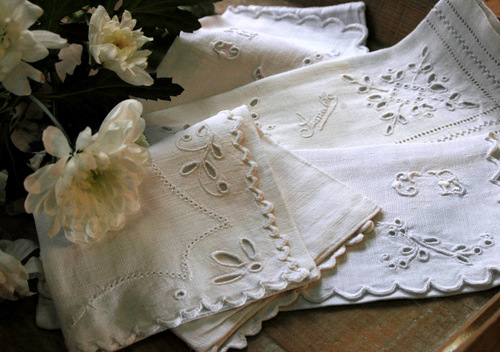
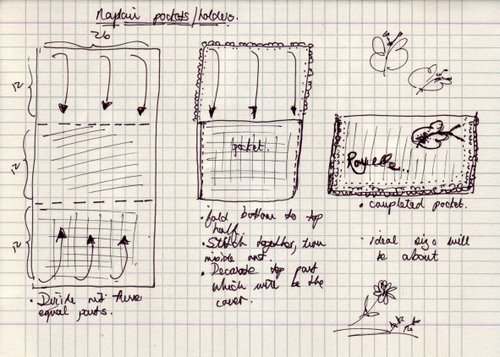
To make these little napkin/holders/pockets, are SO easy and the decoration can be played around with to your heart’s content. Use colourful fabrics, embroider your family members’ name on each , use lace or ribbons or do some cross stitching to give each owner his/her own pocket/holder. Make a double set of holders…one on the table and one in the wash. They make for good gifts as well, along with a set of napkins, signed with your own little logo!
From the scribblings in my notebook you can get an idea of how they fold and stitch together. But go and sit and work it out yourself and make it according to your size napkins and your desires!


If you have a meal consisiting of food to be eaten with your hands, especially seafood, or maybe ribs, or chicken wings…then stay away from your lovely napkins! And definitely from paper napkins! Ususally your host or yourself will place a small bowl of water with a lemon slice or even a flower or mint next to each plate. But I have found that men with big hands tend to struggle with the little bowl of water and I am always afraid of splashing my water all over the table…. I prefer to serve a warm face cloth or dish cloth, wrapped in foil alongside each plate.
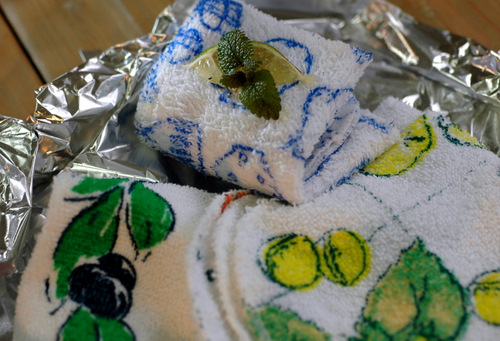
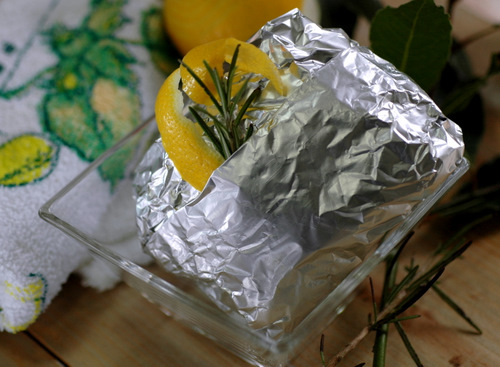
Wet your cloths with hot water, wring, place a lemon slice with mint or another fresh herb, or a flower decoration on the cloth , wrap them warm in foil and keep in a warm oven until the meal is on hand. Decorate each parcel with a sprig of herb or flower or slice of lemon, depending on your season. Place each warm parcel in little bowls by each plate and thus providing each guest his/her own warm foil parcel. By the time they use it, the foil will have cooled down, but the cloth inside will still be warm. Guests, usually enjoy the little attention and detail and especially the warm cloth/napkin.
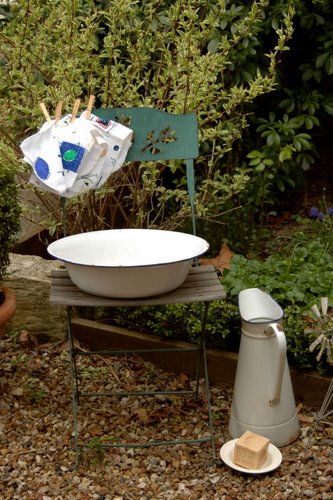
For entertaining outdoors, a good and fun idea can be to provide a stand or table or even chair with a bowl or any other interesting container of fresh water, filled with lemon, mint, flowers. Make a tap/faucet from a small watering can…..hang small towels close by…, some hand cream for the ladies….be creative and make it inviting and fun to rinse those hands after digging into a good al fresco meal!
Trucs et astuces de nos grands-mères.

- To get your hortensias/hydrangeas blue, bury some rusted nails close by the roots. Do it early in the spring season.