Who doesn’t know les madeleines de Marcel Proust..? Those well-known shell shaped petits gateaux with their particular little hump on the one side and the ribbed shell opposite side.


Recipe translation:
- 90g butter and a little more for the pans
- 90g flour
- 75g sugar
- 10g honey
- pinch of salt
- 2 eggs
*Melt the butter. In a bowl, whisk the eggs, sugar and salt for 5 minutes. Add the flour. Stir in with a wooden spoon. Add the cooled off melted butter and the honey. Leave to rest in the refrigerator for at least one hour.
Preheat the oven to 220 degrees C. Remove the dough from the fridge and leave at room temperature for 30 minutes. Melt the extra butter and brush the insides of madeleine pans. Fill the pans with the dough, about 1 tsp into each cavity. Bake for 10 minutes(5 minutes for the mini madeleines). Remove from the pans before completely cooled.
Extract from Proust, la cuisine retrouvé, Le Chêne, 1991. the recipe is created by Alain Senderens, who was inspired by the cooking of Proust.
Suggestions:
- Add the lemon zest of 1/2 lemon
- To get the nice hump on your madeleine, it is necessary to have the dough cool and the oven temperature high.
- Bake the mini Madeleines only 5 minutes.
- I prefer the real old fashioned metal pans. The ribbed shell effect is much more pronounced than when using the silicone pans.
******************************************************************************
-My chickens produce small eggs with large egg yolks and I have to use 2 of them to replace 1 normal egg-

-Zest from a lemon to flavor les madeleines-

***********************************************************************************************
Il etait une fois…La madeleine, histoires et recettes d’un produit d’exeption lorrain – Michel Caffier
(book to be found at Amazon.fr)

Marcel Proust said: (roughly translated from below) “One winter’s day, when I came home; my mother saw how cold I was and offered me a cup of tea. I didn’t usually drink tea and I refused, but then I changed my mind. she brought me some small cakes called madeleines which seemed to be molded in a scallop shell. Still overwhelmed by the sad day I had and the sad day that lay ahead , I mechanically brought a teaspoon of tea, in which I softened a piece of madeleine, to my lips. At that moment, when it touched my palate, I trembled, suddenly very aware of something extraordinary happening to me. I was overcome with a deilcious pleasure; isolated, without notion of its cause..I ceased feeling mediocre, ordinary, mortal. Where could this powerful joy have come from? I sensed it had something to do with the tasting of this tea and cake.”

This wonderful little book is all about la madelene, how this delicious French petit gateau was born, how it got its name, how it is labelled;, sold at the stations by young maidens, the influence of St Jacques de Compostelle and it ends with the traditional recipe, which is the ones I used, and a list of additions to change the madeleine with some chocolate, hone, lemon and more.

Legend has it that one day, at the chateau de Commercy of Stanislas, in the middle of a beautiful meal, the maître d’hotel reported an incident to the prince: out of anger towards his chef, the assistant chef took out his anger on the serving of the dessert. It is unsure in which form this revenge was, but the fact was, that there was no dessert to be served. A maidservant, witnessing the distress of the maître d’hotel, offered him a solution.Tender petits gateaux, the way her grandmother made it. Necessity reigns and Madeleine Paulmier was given permission to present her little cakes for dessert. Of course it was a huge success and so la Madeleine was born.
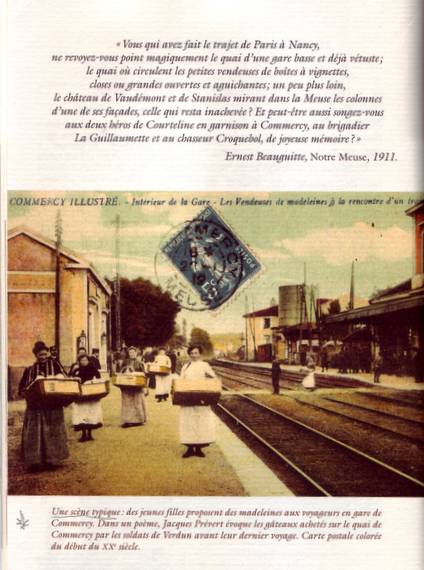
A typical scene at the station of Commercy: young women selling madeleines to travelers. In a poem, Jacques Prévert recalls these little cakes so often bought by the soldiers of Verdun with their last trip. (postcard dated beginning XXth century).
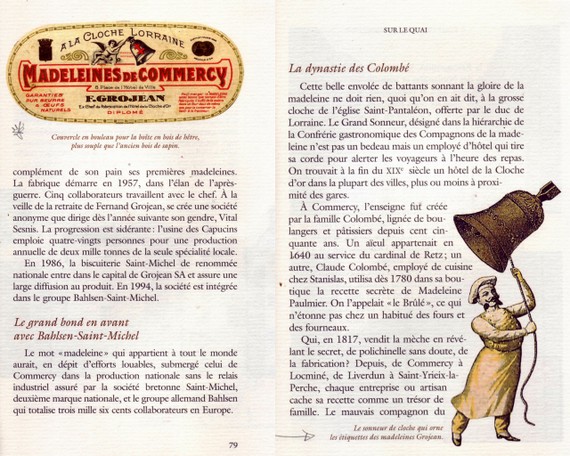
At Commercy, the sign the bell ringer was created by the Colombe family, a line of bakers for over 150 years.From the 1780’s, Claude Colombe used the secret recipe of Madeleine Paulmier.
à la prochaine
Ronelle



 Myfrenchkitchen